

Past Lives (2023)

“What if this is a past life as well, and we are already something else to each other in our next life? Who do you think we are then?”
– Hae Sung, Past Lives
Watched on 1/3/25 on the flight back from family vacation to Costa Rica.
Spoilers Ahead!
It is possible to have ghosts in your life without being haunted. Ghosts of who someone could have been or perhaps who they were to us in another life. Some may choose to reflect on those what-ifs, perhaps even indulge in them. It is sometimes not even the people themselves that we ponder over, but what those people may represent to us. That is the overarching theme of writer-director Celine Song’s film Past Lives, but the thematic intricacies of this story go beyond even just that.
Starring Greta Lee, Teo Yoo, and John Magaro, it follows two childhood friends over the course of 24 years while they contemplate the nature of their relationship as they grow apart, living different lives.
– “Past Lives (film),” Wikipedia
Song set out to capture the complexity that comes with moving forward with your life, and how that sometimes means people who could have been your forever are not. While talking at a panel for Variety‘s “10 Artisans to Watch,” the film’s cinematographer Shabier Kirchner explained how he and Song sought to “capture that feeling of time” and how quickly it gets away from us. Song and Kirchner are able to pick up on the contemplative, semi-nostalgic theme visually by using 35 mm film and a more muted, cool-toned color grading. As a way of showcasing the, using Kirchner’s words from the panel, “fleetingness” of time, much of the movie is intercut with a couple seconds-long medium shots of the mundane to express the passage of time in the characters’ lives. This is done masterfully, it is easy to believe this film takes place during a few periods of time over the course of twenty-four years. To round out this visual capturing of time, the dreamy score composed by Christopher Bear and Daniel Rossen adds the perfect final piece needed to complete Song’s vision. The filmmaking is then bow-tied with the gorgeous writing acted out perfectly by the central acting trio.
A Film Summary
Skip if you don’t care.
The film follows Na Young, a young girl who immigrated with her family from Seoul to Toronto when she was twelve. Before this life-changing move, Na Young felt the sparks of childhood love with her classmate Hae Sung. Naturally, as Na Young immigrates with her family, this potential young love is stopped before it even really started. Na Young arrives in North America and changes her name to Nora, and the pair lose touch with each other.

Nora and Hae Sung go on to live their teenage and young adult lives without each other, with twelve years passing before the film resumes the story. Nora has moved to New York for college and to pursue a writing career while Hae Sung completed his mandatory Korean military service before moving to China to learn Mandarin. One morning, while goofing around on the phone with her mother, Nora finds that Hae Sung has been looking to for her on Facebook. Nora reaches out and the two for all intents and purposes date via Skype for a period of time. It is important to note that all communication between Nora and Hae Sung is in Korean. Over time it becomes clear to Nora that if she continues this relationship with Hae Sung, it will only hurt them both in the long run. There are no long term plans for either of them to stay in the other’s country. Nora already misses Hae Sung all the time, and he her. That feeling will never go away with their current places in life. She asks if they could stop speaking for awhile.
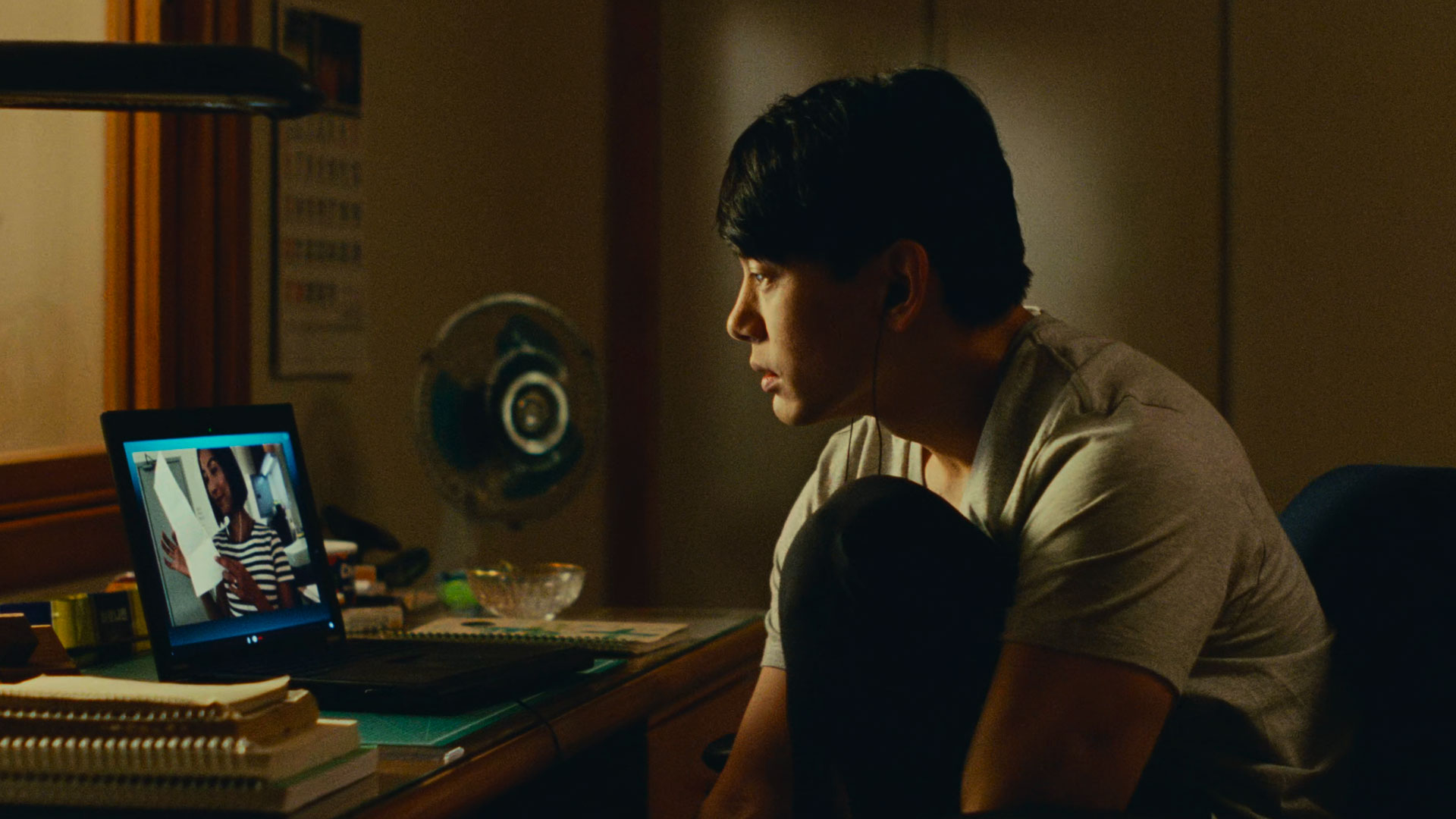
Nora goes to a writers retreat where she meets Arthur. One night, the pair discuss the Korean word In-Yun, which refers to the Buddhist concept of fate in which two people share a cosmic connection in this live that is informed by this connection manifesting through thousands of lifetimes. Nora jokes that Koreans just invoke this idea to seduce people. Nora and Arthur then sleep with each other. While this is happening, Hae Sung, still in China, meets a woman and the pair start a relationship.
There is a word in Korean. In-Yun. It means “providence” or “fate”. But it’s specifically about relationships between people. I think it comes from Buddhism and reincarnation. It’s an In-Yun if two strangers even walk by each other in the street and their clothes accidentally brush. Because it means there must have been something between them in their past lives. If two people get married, they say it’s because there have been 8,000 layers of In-Yun over 8,000 lifetimes.
– Nora Moon, Past Lives (2023)
When we catch up to the present-day, Nora and Arthur are married. Hae Sung, now single, is on his way to New York to visit Nora. This will be the first time Nora and Hae Sung have seen each other in person since they were twelve years old. The pair spend the day conversing in Korean while visiting some tourist spots in New York. At the end of the day, Hae Sung returns to his hotel and Nora returns to her home with Arthur. Arthur, who is aware of all the history between Nora and Hae Sung, begins to wonder if Hae Sung is making Nora have second thoughts about their not-so-perfect love story. Though Nora loves Arthur very much, the purpose of their marriage was for her to secure a green card in the United States. Hae Sung represents an escaped life to Nora, or at least that is how it reads to Arthur. Nora never truly disputes that because it is true. Hae Sung is a part of a life Nora may have lived had her family not left Korea. Hae Sung speaks in Nora’s first language, experienced childhood with her in Korea, and, as Nora herself points out in the film, is “so Korean.” Cuddling in bed together, Nora reassures Arthur that she loves him and is happy.
The following night, Hae Sung comes over to Nora and Arthur’s home. Hae Sung and Arthur finally meet, the pair trying their best to communicate with each other by speaking a little in each other’s native languages. The trio decide to go out to eat, Hae Sung saying he would like pasta. For the most part, Nora translates what Hae Sung is saying to Arthur. At one point during the night, Nora and Hae Sung have a conversation in Korean just with each other. In-Yun is invoked again, with the pair semi-jokingly and semi-seriously hypothesizing what they were to each other in their past lives. Additionally, they discuss what may have happened had Nora never left Korea. They discuss it, but it is quite clear to us viewers that Nora is not necessarily reflecting on this as a desire of hers, but out of true curiosity. Nora excuses herself to the bathroom, leaving Hae Sung and Arthur by themselves. Hae Sung apologizes for leaving him out of the conversation, but Arthur rebukes this by expressing that he was glad to have met Hae Sung.

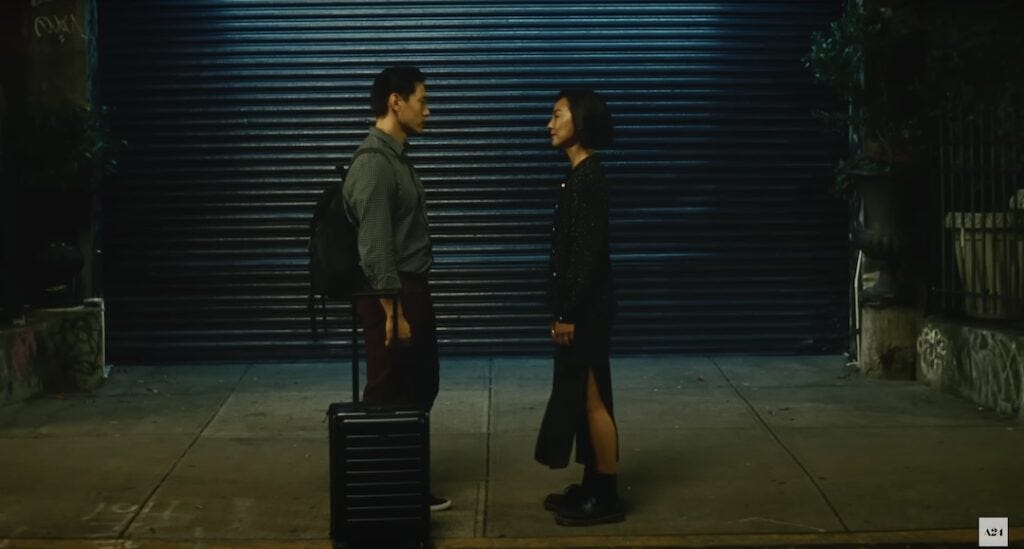
The trio return to Nora and Arthur’s, where Hae Sung grabs his luggage, calls on Uber, and then invites Nora and Arthur to visit him in Korea. When his Uber arrives, Nora walks with Hae Sung to the pick-up spot. During their walk, the pair just continue to share heavy looks. When they get to the Uber, Hae Sung turns to Nora and asks if perhaps this is actually one of their past lives, and what she thinks they will be to each other in the next. She responds that she doesn’t know. Hae Sung tells Nora, “I’ll see you then.” Hae Sung is driven off and Nora walks back to her place where Arthur is waiting on the stoop. The husband and wife share a look, and Nora then cries into Arthur’s arms.
Let’s Talk
My analysis and thoughts about the film.
The acting in this film is phenomenal. This movie has dialogue—though not as much as a other standard drama films—but it does not rely on it in the slightest. Most of the dialogue is in Korean, a language I do not understand, but one quickly forgets that when wrapped up in the beautiful performances from the leads. Nora is played by Greta Lee, delivering a performance with a subtle electricity and a secondary angst. Somehow Lee delivers on a very important character aspect of Nora: she does not actively think about her “past life” and Hae Sung, but the audience can somehow tell it is running in the background. Hae Sung, played by Teo Yoo, masterfully plays melancholy and thoughtfulness. You can tell Hae Sung thinks about Nora quite often, perhaps more so than she ever thinks about him.
The difference between these characters and how they view each other is explained somewhat implicitly, though bordering on explicit. While the plot focuses on the relationship of Nora and Hae Sung, and thus with Nora’s eventual husband Arthur, the most important aspect of this movie is the immigrant element. For a small portion of Nora’s life, she was Na Young, a young school girl living with her family in Seoul. She was in no way Canadian or American, her entire life was Korean. Na Young-turned-Nora left Korea young, at an age that makes cultural adaption much easier to participate in. It is made clear in parts of the film that Nora has adapted to being Korean Canadian and then American, she is not necessarily the same type, for lack of a better word, as Hae Sung is. I believe there’s a line of dialogue in the beginning of the second act where Nora or Hae Sung makes a joke about her being rusty in speaking in Korean. Nora later has a whole conversation with Arthur about how not-Korean she feels when she talks with Hae Sung.
It’s so crazy to see him be this grown-up man with a normal job and a normal life. He’s so Korean. He still lives with his parents, which is really Korean. And he has all these really Korean views about everything. And I feel so not Korean when I’m with him. But also, in some way, more Korean? It’s so weird. I mean, I have Korean friends, but he’s not, like, Korean-American. He’s Korean-Korean.
– Nora Moon, Past Lives (2023)
Hae Sung very much represents a different life to Nora, a past life, that she would likely be living had her family not immigrated. What makes this harder as Nora is not a first-generation North American. She was born and lived in Korea. To Hae Sung, Nora is still Na Young; he asks if that is what he can still refer to her as. This life in the form of Hae Sung is not some alternate reality, it is a life that was already growing in Korea before it was yanked out and replanted somewhere else. While she is very happy and enjoys her life in New York as a writer with her Jewish, fellow-writer husband, it is no surprise that every so often one wonders about what may have been their life in their homeland. Not to put words into the mouths of people, but I assume this may be especially so when you are an immigrant that is a racial minority in the western world.
What stands out about Arthur’s character in particular is that he seems to understand this. Arthur questions Nora about her thoughts on her beginning her life in Korea and if she feels fulfilled being here, in the U.S. with him. I have often heard from those who live in a country where their first language is not the dominant or national one that they can never truly be themselves with others, even their partners, when not speaking in their first language. Whether this applies to people who immigrated during childhood, I don’t know, but clearly Arthur thinks about this a lot. One of the most prominent pieces of dialogue in the film comes from a conversation between the married couple. Arthur tells Nora, “You dream in a language I can’t understand. It’s like there’s this whole place inside you I can’t go.” This exemplifies the interesting writing and acting of Arthur’s character. He is not really jealous of Hae Sung nor does he hold any true resentment or anger towards him. At least not a lot. Arthur genuinely wants to know if his and Nora’s life together is enough for her, if she has any regrets or yearning or unanswered questions about a more Korean life. Nora is happy with her life, the life she has built in both Canada, where her family immigrated to, and New York with Arthur, but she still grieves a life she very well could have but never got to live.

But now let’s look at Hae Sung as a person, not just a personification. As said above, Hae Sung still views Nora through the lens of Na Young, the young Korean girl he once knew. It is exacerbated by Nora being able to engage more with her Korean-ness through Hae Sung in a way she likely was not able to do with her family who also were undergoing their own personal and collective immigrant experiences. Outside of Hae Sung representing a Korean life for her, Nora also genuinely liked the dude. So much so she actually asked for them to stop communicating with each other because it hurt to much and was a bit too much of a distraction from the separate lives the pair were living. So, twelve years passes and Nora falls in love and Hae Sung is in a relationship of his own, and that’s just life. When Nora and Hae Sung finally meet in person for the first time in twenty-four years, it is obviously an emotional experience. Hae Sung gets closure from Nora and Nora gets closure from both Hae Sung and her Americanized life.
When the topic of In-Yun is invoked again at the end of the film, it is quite clear now to perhaps the English-only speakers watching the film that the concept does not mean this cosmic connection has to result in a romantic connection in every life. Or, in this case, even if it does involve a half-baked and halted romance, it does not mean that person is the end-all-be-all in this life. Maybe they will be in the next. In-Yun exists between all the souls in one’s life. Hae Sung and Arthur are In-Yun, too. That is why Hae Sung poses his final question to Nora. In-Yun leaves hope for boundless possibilities and boundless combinations of relationships. This is why the final shot of the film is Nora crying into the arms of her husband. She is mourning what could have been with Hae Sung, what had been with Hae Sung, and, I think, the life left behind in Korea.
I loved this film. I remember a feeling of devastation that is so inexplicable, similar to that of Nora’s. Nora is happy with her life, the film makes that clear, but that age-old experience of thinking of what could have been that surely every human experiences can be devastating despite personal contentment. There’s truly so much more I could say and probably should say. I am sure my thoughts are very much all over the place in this review, but that is the beauty of this film. It is a movie driven by the emotions and feelings that drive us most crazy: yearning, curiosity, nostalgia, grief. I am sure a better review would have been written after a rewatch, but I wanted to jot down my raw thoughts post-first watch.
If you somehow got here, thanks for reading.

 Popcorn Ponderings
Leave a comment